
When you carry a firearm, it is essential to make sure you do so safely and responsibly. Choosing your holster and knowing how to wear it are therefore crucial elements in ensuring the safe use of your firearm. Below you will find detailed instructions on how to wear your holster:
-
- on your belt (high ride);
-
- on the hip (mid ride, either with a fixed mid-ride belt loop or a hip plate);
-
- on the shoulder;
in order to maximize your comfort and safety.
How to wear a belt holster?
The positioning and wearing of a holster largely depend on the holster you choose. At GK, our holsters are sold with either a high-ride belt loop or a mid-ride belt loop, but you can always fit an additional system to vary the way you carry.
Our holsters are delivered ready to use, but you may need to disassemble yours. Here's how to proceed:
1. Screw the supplied belt loop onto the back of the holster using the screws provided and the Allen key attached behind the plate.
2. Set up your duty belt in order, placing the firearm on your strong-hand side. All our duty holsters fit intervention belts up to 50 mm.
3. Place your firearm in the holster and make sure it is properly seated in the holster and will not fall out. The safety "click" confirms that the firearm is correctly positioned.
4. Once your firearm is in place, adjust the position of the holster so that it is comfortable and the grip feels natural.
How to fit a hip holster?
Thanks to the GK hip plate, you can carry your holster on the hip or on the thigh. Thigh carry is better suited to motorcycle officers, who need lower access to their firearm.
1. To begin, attach your holster to the hip plate using the screws provided and the Allen key attached behind the plate.
2. Arrange your duty belt in order, positioning the tactical plate's belt loop on your strong-hand side.
3. Put the duty belt on and close the buckle, then fasten the thigh strap of your tactical plate.
4. Some adjustments may be necessary: you can rotate the belt loop on the duty belt, adjust the height of the holster on the plate, and adjust the thigh straps.
As you move, the plate follows your movements in all circumstances thanks to its pivoting strap system.
5. Place the firearm in the holster and make sure it is correctly positioned and will not fall out.
6. Before carrying the firearm in public, be sure to test the security and accessibility of your firearm in the holster. Check that the firearm is easily accessible when needed, but also that the holster retains it securely.
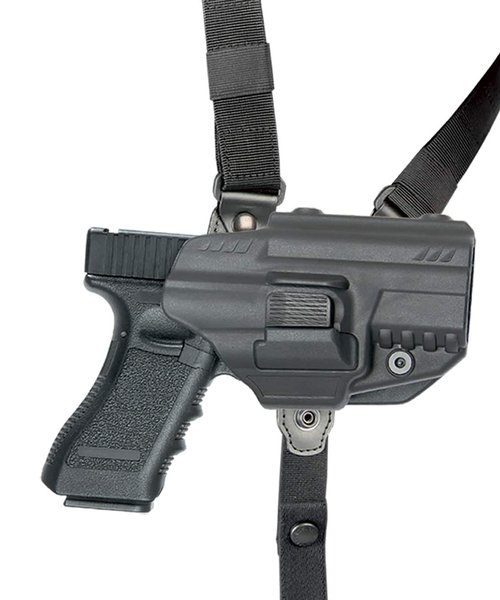
How to fit a shoulder holster?
At GK, we have a model that includes the shoulder harness + the holster. We also offer a harness on its own compatible with 870 holsters. Here's how to fit it:
1. Slip the harness over one shoulder
2. Insert your firearm into the holster. Make sure the firearm is properly seated in the holster and will not fall out.
3. Some adjustments may be necessary and should be made with the harness laid flat. Adjust the strap settings so that the holster is easy to reach and the grip feels natural.
Using a firearm holster is an important step in ensuring the safe and responsible use of your weapon. Whether you carry it on your duty belt, on your hip or on your shoulder, it is crucial to follow the steps above carefully. By making sure your holster is properly adjusted and your firearm is securely seated, you will be able to carry your firearm safely and with complete confidence. It is therefore essential to follow this advice when fitting your holster in order to guarantee the safe and responsible use of your firearm.